War Thunder Review
War Thunder Overview
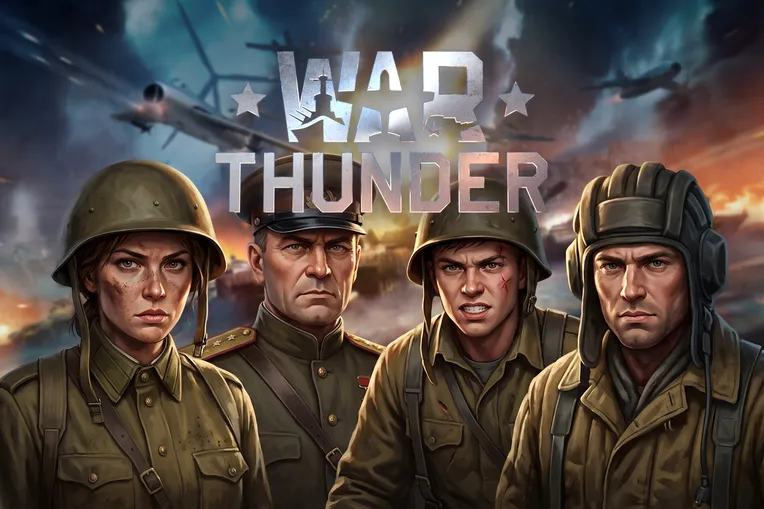
War Thunder turns military history into a huge playable garage, letting you command aircraft, tanks, helicopters, and warships across land, air, and sea. Gaijin Entertainment’s free-to-play combat MMO covers machines from the early 20th century through modern warfare, so your interests can wander from World War II fighters to far newer armored hardware without changing games.
A verified vehicle count lists 3,496 modeled machines, while Gaijin says its battlefields span more than 140 maps based on major historical theaters. Those numbers matter because they create genuine breadth. You can follow one nation’s technology tree, switch vehicle classes, or abandon the ground entirely when the call of the cockpit becomes too loud.
It is available across Windows, macOS, Linux, PlayStation, and Xbox, with Gaijin supporting cross-platform play on shared servers. Since its open beta in 2012, it has grown far beyond its original aircraft focus. Tanks arrived in 2014, with naval forces and helicopters joining the lineup later. Pick a branch, clear some hangar space, and prepare to develop opinions about military hardware you previously knew only from grainy documentaries.
War Thunder Gameplay and Core Loop
War Thunder’s core loop is a compelling cycle of choosing a vehicle lineup, entering objective-based combat, and advancing toward increasingly sophisticated machinery. Battles can involve up to 32 players split between two sides, with victory tied to capturing points or eliminating the opposition. That gives each deployment a clear purpose: contest territory, break the enemy force, and make your chosen machine count.
Twenty minutes, several tons of trouble
Give the game 20 minutes and its central appeal becomes obvious. You select a vehicle type and difficulty setting, join a large battlefield, then fight over objectives while other players bring their own machines and priorities to the scrap. Aircraft create the fantasy of aerial combat, ground vehicles turn the fight into an armored contest, and naval craft exchange fire across the water. Combined-arms battles let these military branches rub shoulders, which is where the sandbox earns its scale.
The maps represent real-world locations and battle theaters, keeping the historical framing close even when a match develops into multiplayer chaos. Custom events can impose limitations or alternate victory conditions, while PvE options include dynamic historical campaigns and solo missions. Competitive PvP remains the main attraction, but there is room to step away from the usual capture-and-eliminate structure.
Arcade first, simulator when you mean it
Three realism tiers let you choose how sternly the game should fold its arms at you. Arcade mode is the approachable entry point, Realistic mode moves toward stricter simulation, and Simulator mode is aimed at players who want the full-discipline version of the military fantasy. That range is crucial. You can arrive for accessible vehicle combat, then increase the demands as your confidence catches up with your ambition.
The breadth also keeps one rough match from defining the whole experience. A frustrating tank battle can send you toward aircraft, ships, helicopters, another nation, or a different realism setting. There is always another branch of military machinery waiting to turn your evening into a procurement meeting with explosions.
Is War Thunder Pay-to-Win?
War Thunder is free to play, and its documented problem is clearer as grind and progression pressure than as a definitive case of pay-to-win. Gaijin’s official overview confirms free access, but it does not itemize the current shop inventory or pricing, so exact claims about every product or cost would be guesswork. What can be judged clearly is the tension around the game’s economy.
That tension exploded in May 2023 after an economic change drew a major community backlash. Steam received more than 65,000 negative reviews by May 22, pushing recent sentiment sharply downward. Gaijin reverted the planned change, apologized, and announced an economy revision. Steam later marked reviews posted after May 19 as off-topic because the disputed update had already been removed.
So, is it pay-to-win? The available evidence does not establish that spending automatically buys victory, but it does show that players care fiercely about how quickly progress is earned and how economic changes affect the climb. The sensible free-player approach is to treat this as a long-term military hobby rather than a sprint through every technology tree. Choose the vehicles and nations that excite you, resist completionist panic, and let the free path prove its value before spending anything. Your wallet does not need to achieve air superiority on day one.
War Thunder Progression and Long-Term Play
War Thunder’s long game is about climbing national technology trees, unlocking more advanced vehicles, and continually finding a new corner of its enormous roster to master. Progress moves from earlier machines toward later military hardware, giving every branch a visible destination. The reward is less a conventional final boss and more the next aircraft, tank, helicopter, or ship that changes what you can bring into battle.
The hangar is the endgame
There is no single documented endpoint where War Thunder declares the campaign complete and hands you a ceremonial wrench. Its enduring hook is expansion. You can advance further within one nation, begin another tree, change combat branches, or move from Arcade toward Realistic and Simulator play. Regular updates add vehicles, maps, missions, and nations, so the finish line keeps rolling away with suspicious enthusiasm.
The scale also explains why the grind can become the central friction. Thousands of vehicles make full completion an enormous goal, and the 2023 economy dispute showed how sensitive the community is to progression pacing. The smart response is focus. Pick a nation, select a manageable branch, and pursue the hardware you actually want rather than treating the whole catalog as a checklist. Trying to collect everything is how a hobby becomes an unpaid quartermaster position.
For players who enjoy specialization, that long runway is the point. Learning a vehicle class, moving into stricter modes, and opening later sections of a technology tree provides weeks or months of direction without requiring a traditional endgame campaign. There is always another machine in the hangar doorway, revving impatiently.
Is War Thunder Worth Playing?
War Thunder is worth playing if the fantasy of commanding a vast range of historical and modern military vehicles outweighs your impatience with a long progression climb. The combination of aircraft, armor, helicopters, and naval craft is difficult to shrug off, while three realism settings give both curious newcomers and committed simulation fans somewhere to start.
At 3.55 out of 5, it earns a strong recommendation with one practical condition: love the battles, not the completion percentage. Military hardware enthusiasts and competitive vehicle-combat players should clear space for the download, while anyone demanding a quick route through every unlock should skip the completionist mission. Choose one branch, enter Arcade, and see which machine steals your weekend first.