Merge Gardens Review
Merge Gardens Overview
Merge Gardens makes one overgrown estate do the work of three games, combining object merging, match-3 puzzles, and a magical restoration mystery. Futureplay’s cozy free-to-play puzzler casts you as Daisy, whose inherited garden needs clearing while the fate of her missing uncle hangs over the story.
Released in 2020, it is available on iOS and Android, plus Windows and macOS through Plarium Play, with a Windows release on the Microsoft Store. Mobile progress can sync with the Plarium Play desktop version through a Plarium ID. Google Play lists a 4.3 out of 5 rating, while Apple’s App Store lists 4.6 out of 5. Plarium also reported nearly 17 million players across all platforms during the game’s fifth-anniversary celebration.
That reach makes sense. This is aimed squarely at players who want gentle fantasy, tidy little upgrades, and enough puzzle variety to stop the gardening from becoming background noise.
Merge Gardens Gameplay and Core Loop
The core loop keeps your hands busy by turning every merge, harvested flower, and completed puzzle into another patch of garden reclaimed. You merge three matching objects, use flying creatures to harvest nectar from flowers, and spend that nectar clearing locked cells. As the clutter retreats, the estate expands and makes room for more objects, decorations, and story.
Twenty minutes, several small victories
A short visit can bounce between organizing the garden, combining items, directing creatures toward useful harvests, and tackling a match-3 board. It is a good rhythm for tea-break play. One task sprouts two others, your carefully arranged corner starts overflowing, and suddenly you are managing a tiny botanical bureaucracy.
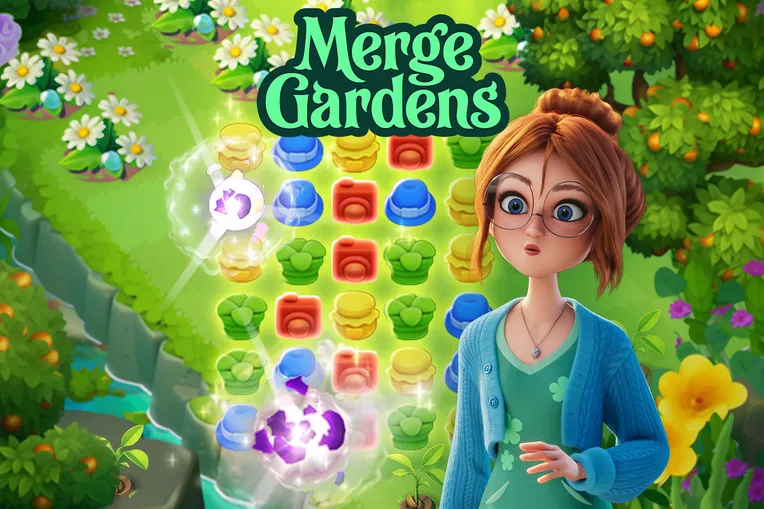
The match-3 stages retain familiar lives and boosters, but their visual identity has improved since launch. A substantial 2023 makeover replaced generic fruit tiles with objects better suited to the mystery, including books, cameras, and hats. The interface also received smaller, brighter icons and a cleaner overall presentation. Those details help the puzzle boards feel connected to Daisy’s peculiar estate instead of borrowed from another cupboard.
Two puzzle styles sharing one garden
The merge board supplies the soothing, open-ended fiddling. Match-3 stages bring firmer goals and the possibility of failure. That contrast is the game’s main trick: when arranging and harvesting start to feel automatic, a board asks you to think in moves and combinations instead.
There is some friction in the marriage. A Google Play reviewer argues that the match-3 component clashes with the identity of a merge game, and anyone seeking uninterrupted garden organization may agree. Yet players who enjoy switching mental gears get the better deal. There is nearly always another useful action waiting, whether that means cracking a puzzle or turning three modest objects into one much more satisfying prize.
Is Merge Gardens Pay-to-Win?
Merge Gardens is not pay-to-win in the conventional sense, because its documented goals revolve around restoration, puzzles, and story rather than defeating other players. It is free to download, and its match-3 structure includes lives and boosters. Plarium also identifies in-game currencies, gift bags, and high-value rewards, although its public overview does not spell out exact storefront prices or purchase pressure.
The practical concern is convenience, not competitive supremacy. Lives can limit repeated attempts at puzzle boards, while boosters can soften difficult stages. That is familiar free-to-play friction, but calling it a whale-driven contest would oversell the problem when there is no documented competitive ladder at the heart of the game.
There is a sensible free path. Anniversary activities have included claimable rewards, mission-board challenges, gift bags, and event currency, showing that active players can collect useful extras through play. Treat boosters as a reserve for stubborn boards, claim event handouts when available, and let patience do the expensive work.
Merge Gardens Progression and Long-Term Play
Long-term progression is about steadily opening the estate, building longer merge chains, and returning for fresh tasks rather than racing toward a traditional endgame. The garden-clearing framework remains recognizable from the 2020 launch: harvest nectar, free locked spaces, solve boards, and keep expanding. The pleasure comes from watching an unruly map become a place you have shaped.
The garden keeps finding chores
Story gives that repetition a destination. Daisy is restoring an inherited mansion garden while investigating her missing uncle, so each newly accessible patch carries more purpose than a bare level number. Decoration adds another reason to care about the space, while daily-style tasks and special challenges supply smaller targets between major expansions.
The fifth-anniversary Assembly Event illustrates how the live game can dress up that routine. Players collected and stored event currency, completed festive activities, decorated an anniversary scene, and worked through exclusive Mission Board challenges. It is the same basic appetite for collection and completion, served with a party hat.
A long-running merge game inevitably risks grind, especially when familiar harvesting and puzzle steps repeat across a large estate. One Google Play review also reports persistent lag, freezing, and trouble completing events late in progression. That is a real complaint, though one report cannot describe every device or player experience. The fair takeaway is to expect repetition and keep an eye on performance as your garden grows.
Cross-platform syncing gives committed players a useful escape hatch from a single screen. You can carry mobile progress into the Windows or macOS Plarium Play version, then continue sorting Daisy’s magnificent pile of garden business with keyboard and mouse controls. Plenty to prune, then.
Is Merge Gardens Worth Playing?
Merge Gardens is worth trying if you like cozy restoration but want more to do than wait for timers and admire the shrubbery. Its blend of merging, harvesting, decorating, match-3 boards, and mystery gives each return visit several possible goals. The 2023 visual overhaul and continued event support also show a game that has grown well beyond its original presentation.
Garden organizers and casual puzzle fans should plant themselves here, while merge purists who resent match-3 interruptions may prefer to skip the estate tour. For everyone else, it is free to sample, easy to understand, and dangerously good at making one cleared square lead to the next.